CRM CLEANUP · DEDUPLICATION · MIGRATION
Legacy Donor Data Recovery
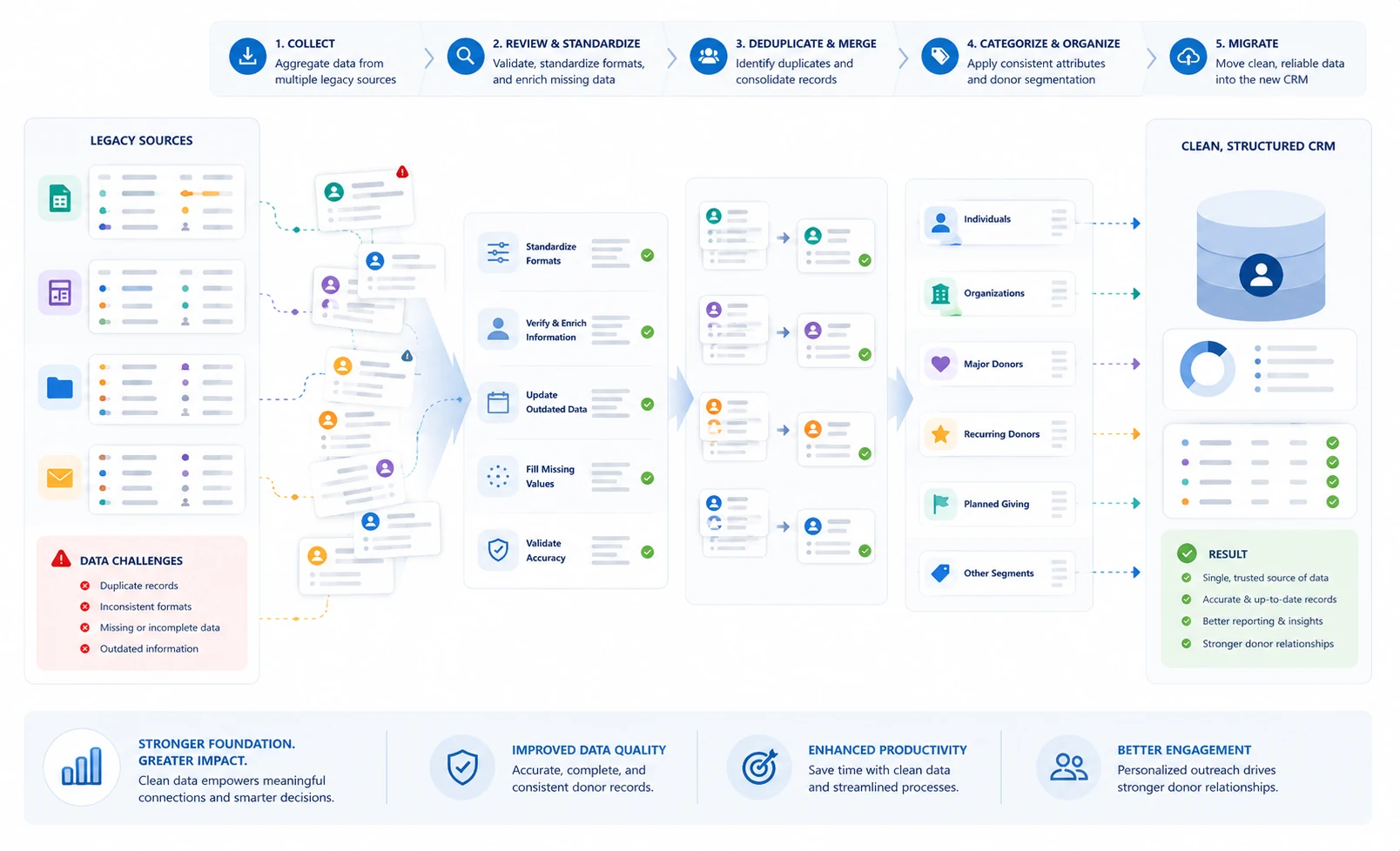
Years of donor history were recovered from unsupported software and converted into a controlled foundation for modern constituent management. The work extended beyond extraction: records were interpreted, deduplicated, standardized, mapped to Salesforce NPSP and online giving platforms, and followed by new procedures for capturing, maintaining, archiving, and governing data.
Operating Context
- A nonprofit organization needed historical donor information for outreach, segmentation, reporting, stewardship, and migration into Salesforce NPSP and modern online giving platforms.
- The records were stored in obsolete, unsupported software with limited documentation and no dependable vendor support path.
- The historical information represented organizational memory, but it could not be treated as trustworthy until the data structure, duplicate patterns, field meanings, and intended uses were understood.
- The project also created an opportunity to replace an informal legacy practice with a controlled process for future data capture and maintenance.
Constraints & Failure Points
- The legacy database did not align with the field structure or import requirements of Salesforce NPSP or current online giving systems.
- Extracted records included duplicate constituents, incomplete fields, inconsistent names, outdated contact information, unclear categories, formatting problems, and rows whose original purpose was uncertain.
- A direct import would have moved legacy errors into the new CRM, where duplicate relationships and incorrect mappings would be harder to identify and more disruptive to correct.
- Historical records had different levels of reliability. Preserving all extracted data was important, but not every row could be assigned the same confidence or operational use.
- Future data would continue to deteriorate unless the organization established rules for how information was entered, maintained, archived, and transferred among systems.
- The technical migration had to remain understandable to staff who would use the new systems after the recovery project ended.
Success Criteria
- Recover the maximum usable donor history while preserving the original extraction for reference and audit purposes.
- Remove or resolve duplicates without incorrectly merging distinct constituents.
- Standardize fields and categories so the remaining data could be mapped to Salesforce NPSP and online giving platforms.
- Document uncertain records and cleanup decisions rather than creating false certainty.
- Validate the import-ready dataset before it entered the new systems.
- Establish repeatable procedures for capturing, maintaining, archiving, and governing data after migration.
- Provide user guidance that explained both the steps and the underlying data-management concepts.
Analysis & Decision Process
- The unsupported software and its available export options were researched until a workable extraction path was identified.
- Approximately 4,500 records were recovered, and the original dataset was preserved so cleanup decisions remained traceable.
- Duplicate analysis used names, contact details, record context, and available relationship information rather than a single field. Approximately 1,500 duplicate records were identified and removed from the working dataset.
- Fields were cleaned and standardized, including names, addresses, categories, contact information, and values needed for segmentation or migration.
- Records with unclear meaning or insufficient evidence were documented separately instead of being forced into an unsupported category.
- Mappings were designed around how Salesforce NPSP and online giving platforms would use constituent, gift, campaign, communication, and relationship information.
- The remaining records were validated before import preparation and renewed outreach.
- New operating procedures defined how data should be captured at the point of entry, which fields were required, how updates should be handled, when information should be archived, and how records should move between systems.
- User guides were written to train colleagues on the new tools, the revised workflow, and the concepts behind data consistency, deduplication, controlled fields, and record stewardship.
Outcome
- Approximately 2,300 usable donor records were recovered and made available for CRM-based outreach, segmentation, reporting, and stewardship.
- The organization regained a meaningful portion of its constituent history.
- Cleaner mappings reduced the risk of contaminating the new CRM.
- Documented exceptions gave staff a realistic understanding of what the recovered data was useful.
- The migration became the starting point for a controlled data-management process rather than a one-time cleanup event.
- Written procedures and user guides made the new approach transferable to colleagues and reduced dependence on individual memory.
Lasting Value
The project converted inaccessible history into usable organizational knowledge and then protected that value with new governance. Recovery, migration, training, and ongoing data controls were treated as a single, integrated system rather than as separate technical tasks.