KNOWLEDGE MANAGEMENT · OPERATIONAL CONTINUITY
Documentation Library & Known-Issue Workarounds
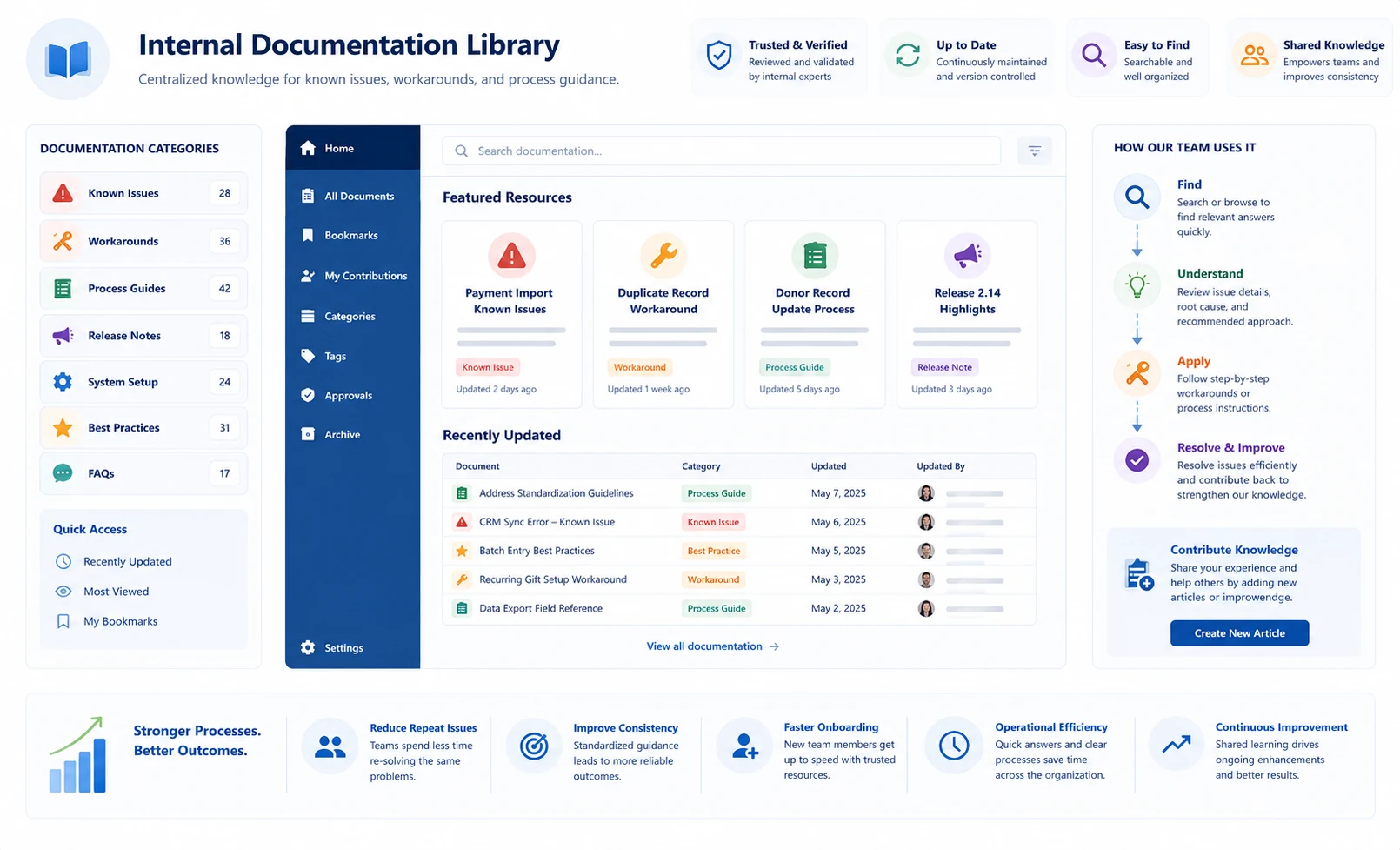
Recurring software limitations, edge cases, and support questions were converted into a practical documentation library organized around the decisions users needed to make. The repository reduced repetitive low-priority support work, provided users with tested self-service guidance, and enabled designated software experts to devote more time to complex problems and escalations.
Operating Context
- Two proprietary software applications supported everyday linguistic and project-management work but also generated recurring limitations, edge cases, and user questions.
- Designated software experts performed their normal linguistic or project-management responsibilities while also helping colleagues diagnose issues and apply workarounds.
- Many questions had already been solved in emails, conversations, old files, or individual memory, but the information was not consistently available at the moment of need.
- Some known issues were legitimate engineering limitations but remained low priority for formal product fixes, making a reliable operational workaround necessary.
Constraints & Failure Points
- Users often knew that a workaround existed but could not find the current version, confirm whether it still applied, or understand the conditions under which it was safe.
- The same low-complexity questions repeatedly consumed expert time because solutions were communicated one person at a time.
- Informal guidance varied according to who was available, which could create inconsistent software use and unnecessary escalation.
- A software menu-based manual was not enough. Users needed guidance organized around the problem they observed, the decision they faced, and the expected result.
- Workarounds had limits. Documentation needed to explain the relevant constraint and identify when self-service should stop and expert or engineering escalation should begin.
- The library had to remain usable without extensive hand-holding and had to be maintainable when software behavior, constraints, or preferred resolutions changed.
Success Criteria
- Create one accessible repository for tested workarounds, known limitations, recurring questions, and decision guidance.
- Organize information around user symptoms, tasks, decision points, and outcomes rather than around software navigation alone.
- Provide enough context for users to apply low-risk solutions independently.
- State when a workaround was safe, what it would not resolve, and when escalation was required.
- Reduce repeated low-priority support requests so designated experts could focus on complex issues, root-cause analysis, and higher-value solutions.
- Capture post-mortem learning so recurring questions could reveal broader process, training, or product problems.
Analysis & Decision Process
- Recurring support questions, known issues, software limitations, and successful workarounds were gathered from direct support experience, emails, conversations, and prior files.
- Content was organized around the most common to least common known issues.
- Instructions included the reasoning behind a step when it affected whether the workaround should be used.
- Direct language and step-based guidance reduced ambiguity and allowed users to confirm whether the expected result occurred.
- The repository was updated when a limitation changed, a better workaround was found, or a repeated question showed that existing guidance was incomplete.
- Recurring issues were reviewed as evidence. High-frequency questions could indicate a training gap, an unclear process, a weak interface, or a product limitation that requires a broader response.
Outcome
- Users gained practical self-service guidance for common software limitations and no longer needed individual assistance for every known issue.
- Designated software experts could provide a tested repository link or entry instead of repeatedly recreating the same explanation.
- Expert time shifted toward complex troubleshooting, novel issues, escalation, and solutions that required deeper analysis.
- Support became more consistent because users received the same current guidance regardless of which expert was available.
- The library reduced dependence on individual memory and made operational knowledge available to software users.
Lasting Value
The documentation library transformed repeated support into reusable operational capacity. It improved user independence, protected expert time, and ensured that known low-priority software limitations did not continue to create high-cost interruptions.