AI-ASSISTED DEVELOPMENT · SYSTEMS THINKING · HUMAN QUALITY CONTROL
Building a Professional Website with AI
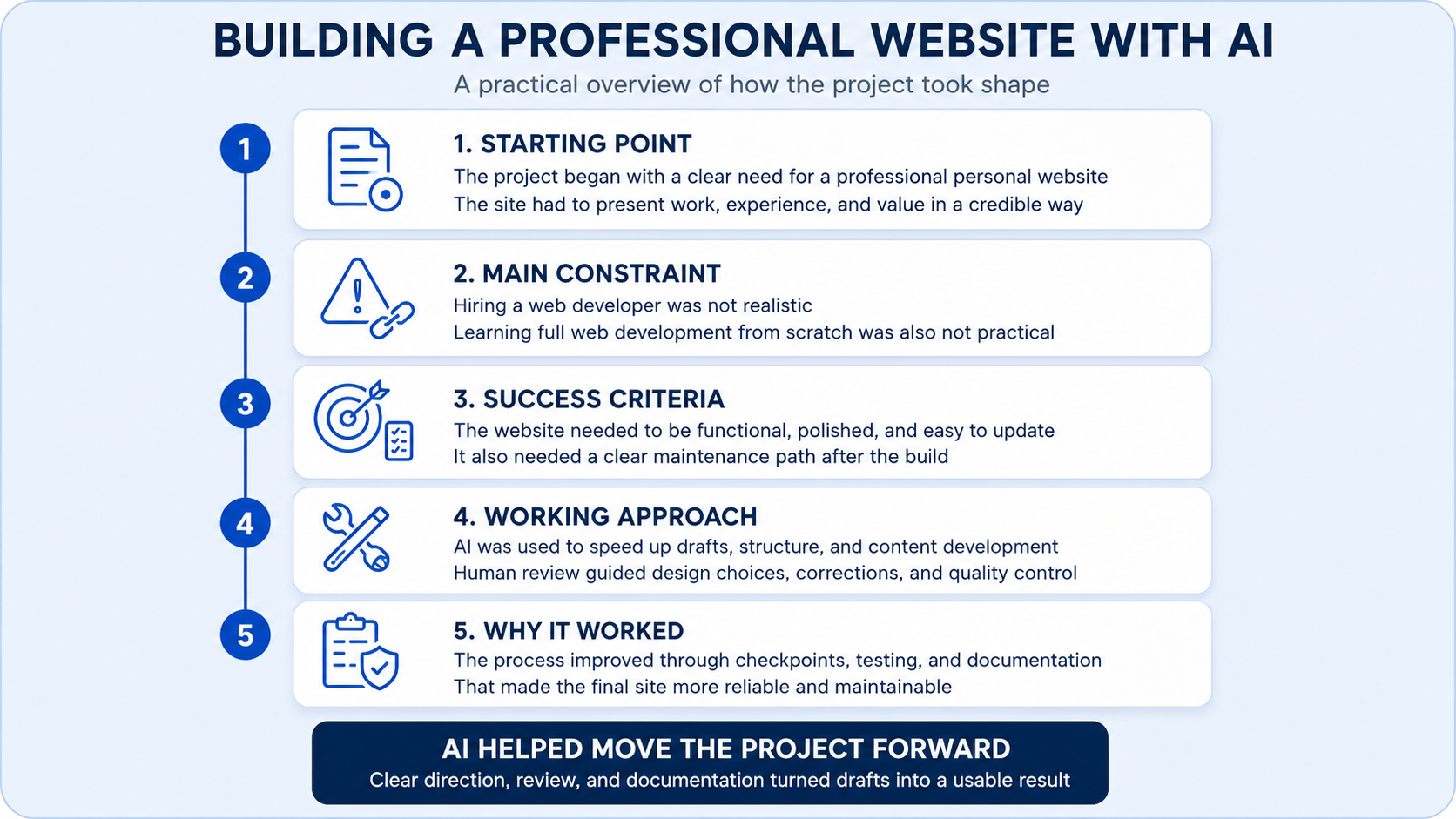
A professional portfolio website was developed despite a limited budget and a practical gap in web development skills. The project became successful only after AI-generated work was placed inside a controlled design and quality process with explicit requirements, shared visual references, checkpoints, complete file packages, testing, and documented maintenance procedures.
Operating Context
- The website needed to present professional experience, capabilities, case studies, a web resume, a downloadable ATS-friendly resume, personal context, and privacy-conscious contact options more effectively than a conventional document alone.
- Hiring a professional web developer was not financially practical, and pausing the project to acquire full web-development expertise was not a realistic use of time.
- AI could generate code, layouts, graphics, and copy quickly, but the final product still needed to appear coherent, credible, responsive, and maintainable.
- The site had to function across desktop, tablet, and mobile displays and remain editable without permanent dependence on a developer.
Constraints & Failure Points
- Early outputs moved into code before the design system, content architecture, file structure, and acceptance criteria were sufficiently defined.
- Several versions resembled a resume or Word document converted into webpages rather than a deliberately designed professional site.
- One preview referenced stylesheets, scripts, and images that were missing from the delivered package, causing the page to appear largely unstyled.
- Other defects included inconsistent visual language, image artifacts, weak hierarchy, duplicated or mismatched icons, unreadable text, generic AI-sounding copy, requirement drift, and gaps between approved mockups and implementation.
- AI generation made it easy to produce a large amount of work quickly, but that speed also allowed inconsistencies to multiply when each output was not reviewed against a common standard.
- The fixed constraints included budget, privacy, professional credibility, responsive behavior, and maintainability. Technology choices, components, prompts, checkpoints, and deployment approach remained flexible.
Success Criteria
- Produce a polished, recruiter-facing website with a consistent visual system and clear professional narrative.
- Support desktop, tablet, and mobile layouts without losing hierarchy or readability.
- Protect personal contact information through privacy-conscious presentation and contact options.
- Deliver complete, self-contained files with working dependencies, assets, navigation, and forms.
- Create a manual maintenance process for local preview, folder preservation, content revision, testing, and eventual publication.
- Use AI as an accelerator while retaining human control over requirements, judgment, quality, and acceptance.
Analysis & Decision Process
- The project was reframed as a systems and quality-control problem rather than as a request for AI to produce an entire website in one pass.
- Audience, content hierarchy, visual direction, privacy requirements, file structure, deployment model, responsive expectations, and acceptance criteria were documented explicitly.
- Resume evidence, professional history, images, page requirements, and direct feedback were supplied as source material rather than allowing generated copy to invent a generic professional identity.
- AI was used iteratively to generate HTML, CSS, JavaScript, Astro components, SVG icons, responsive layouts, optimized images, navigation, forms, case-study structures, and documentation.
- Each output was reviewed as a quality-control checkpoint. Missing dependencies, artifacts, inconsistent image and pane borders, weak captions, duplicated elements, poor hierarchy, unreadable text, and requirement drift were identified and returned for correction.
- An approved homepage became the shared visual reference for typography, spacing, navigation, cards, imagery, and responsive behavior.
- Later pages reused common components and rules instead of being designed independently.
- Complete ZIP packages replaced piecemeal file delivery, reducing broken links and missing assets.
- Each checkpoint included local-opening instructions, a test plan, and a consistent folder structure so the work could be verified outside the generation environment.
Outcome
- The project moved from inconsistent page generation to a controlled, repeatable build process anchored by an approved design reference.
- Shared components and responsive rules improved consistency across the homepage, case studies, resume, navigation, and supporting pages.
- Complete file packages reduced missing dependencies and made local testing more reliable.
- The final workflow closed the practical skills gap without requiring the site owner to become a software engineer or remain permanently dependent on a developer.
- Documentation established a reliable path for previewing, updating, testing, preserving, and eventually publishing the site.
- The project demonstrated that AI-generated work can reach a professional standard when prompts, constraints, visual inspection, testing, and human acceptance are treated as required controls rather than optional review.
Lasting Value
The useful result was not simply a website. The project established a repeatable method for using unfamiliar technology responsibly: define the system, control the inputs, review each checkpoint, verify the complete output, and document how the product will be maintained after generation ends.