CLASSIFICATION · SEVERITY · CALIBRATION
Translation Quality Rubric & Structured Review
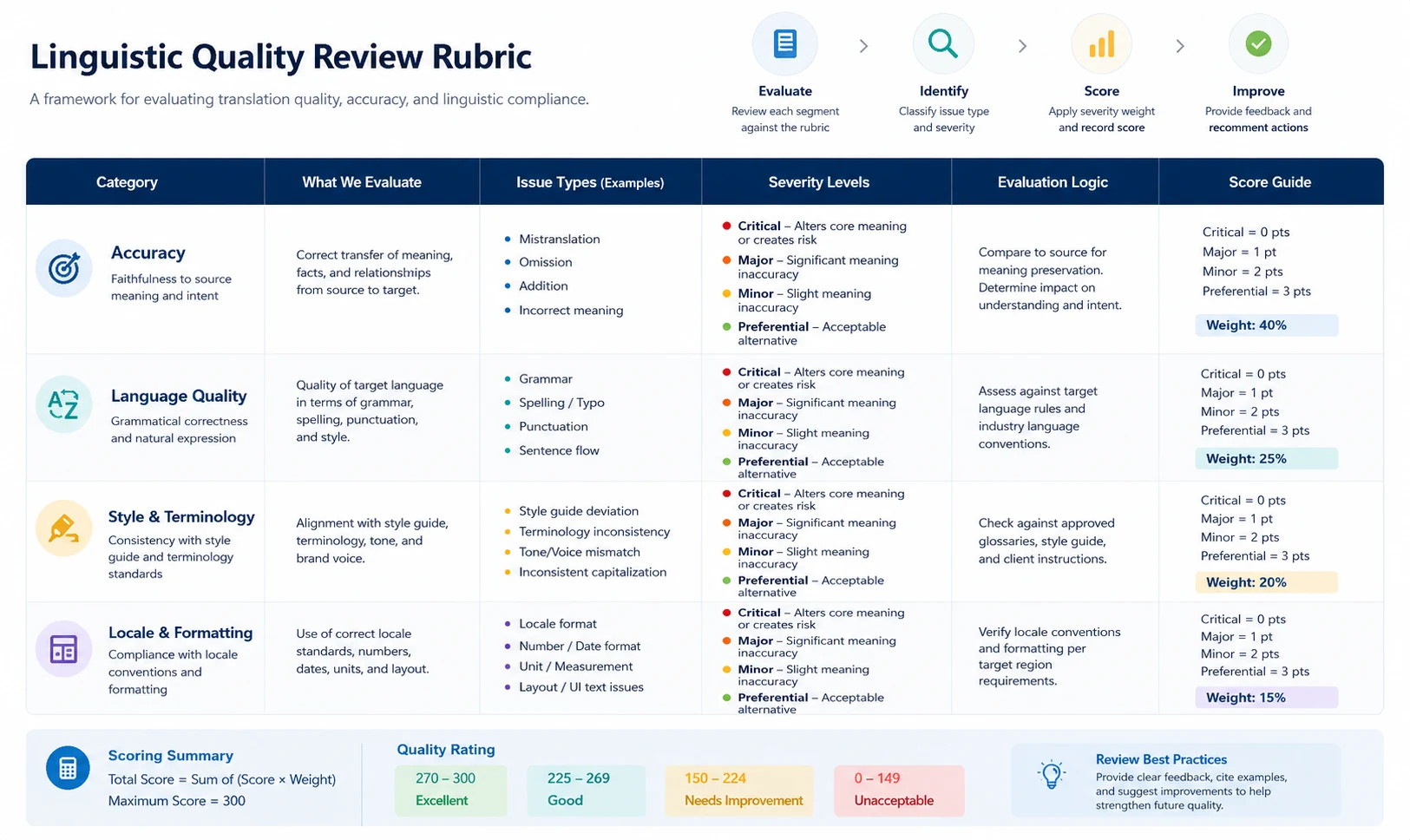
A structured quality-review framework was used to maintain the performance of already-approved translators and linguists. The combination of a shared taxonomy, expert linguistic judgment, evidence-based severity decisions, and direct corrective feedback reduced subjective review, made disagreements easier to arbitrate, and converted recurring errors into targeted training and process improvement.
Operating Context
- Approved linguists and translators worked across regulated, technical, and client-sensitive content where accuracy, controlled terminology, regional requirements, style expectations, and functional use all affected quality.
- Review decisions influenced rework, deadlines, vendor performance records, future assignments, and confidence in the final deliverable.
- The review function comprised two responsibilities: identify genuine errors in the current work and help qualified professionals correct patterns that could affect future work.
- A rubric supplied the common structure, but linguistic expertise remained necessary to interpret source meaning, target-language possibilities, context, and the consequences of a proposed correction.
Constraints & Failure Points
- Translation review can become subjective when a reviewer treats personal preference, habit, or stylistic taste as an objective rule.
- Two qualified reviewers may interpret the same sentence differently because language permits multiple valid solutions. A taxonomy alone cannot determine whether an alternative is possible, probable, appropriate, or inconsistent with the intended meaning.
- Acceptable variation may be marked as an error, while a genuine accuracy, terminology, compliance, or functional problem may be understated.
- A severity label without a rationale does not show why the issue matters or what the translator should do differently.
- Controlled language requirements may come from regulators, legislation, product labeling, client preference, industry standards, style guides, or regulated reference materials. These sources cannot be replaced by reviewer preference.
- The process had to correct real missteps without discouraging legitimate professional judgment or forcing all language into a single stylistic pattern.
Success Criteria
- Apply a consistent taxonomy across files, reviewers, vendors, and review cycles.
- Distinguish objective errors from acceptable linguistic variation and stylistic preference.
- Assign severity according to meaning, reader impact, regulatory or legal consequence, functionality, and recurrence rather than irritation or disagreement alone.
- Support findings with the source text, intended use, approved terminology, controlled references, and client instructions.
- Provide feedback that a qualified translator could understand and apply in the next assignment.
- Identify recurring patterns that required coaching, clarification, calibration, or a broader process change.
Analysis & Decision Process
- Source and target content were reviewed together, with attention to meaning, omission, addition, terminology, register, grammar, regional usage, functional requirements, and the reader's likely interpretation.
- Findings were classified using defined categories such as accuracy, terminology, style, function, region, and compliance.
- Regulated or legally controlled terminology was checked against the applicable authoritative sources before a preference was treated as a required correction.
- Non-controlled language was evaluated against professional target-language standards, the intended audience, and the purpose of the content rather than against a single reviewer's preferred wording.
- Severity was tied to the consequence of the issue: whether it changed meaning, created risk, impaired function, violated a controlled requirement, confused the reader, or represented a minor presentational defect.
- Review comments stated the problem, the supporting evidence, the expected correction, and, when useful, the principle that should guide similar decisions in the future.
- When reviewers or translators disagreed, calibration focused on the rule and the range of defensible interpretations. Expert arbitration examined possibility, potentiality, source ambiguity, context, and reader impact rather than merely choosing one word over another.
- Recurring findings were tracked to determine whether the appropriate response was individual correction, targeted coaching, clarified guidance, reviewer calibration, or a change to the process or reference materials.
Outcome
- Review findings became easier to classify, explain, compare, and resolve.
- Approved linguists received corrective feedback that preserved professional judgment while making the applicable limits clear.
- Project teams could distinguish a one-time error from a pattern requiring training or closer monitoring.
- Reviewers gained a shared language for disagreement, reducing unnecessary rework caused by subjective preference.
- Controlled terminology and compliance requirements remained anchored to authoritative sources, while non-controlled language continued to meet professional writing standards.
- Calibration decisions created reusable guidance for later files, reviewers, and vendors.
Lasting Value
The framework turned review into a controlled learning process: the rubric established boundaries, expert judgment interpreted the language inside those boundaries, and documented feedback improved future decisions rather than merely correcting the current file.